What to Do in the First 30 Minutes After a Burst Pipe in Plano
24/7 emergency response across the Plano metro from IICRC-certified water restoration specialists.
- IICRC-Certified (WRT, ASD, AMRT)
- 24/7 Emergency Response
- Direct Insurance Billing
- Locally Owned, Plano-Based
- Free On-Site Damage Assessment
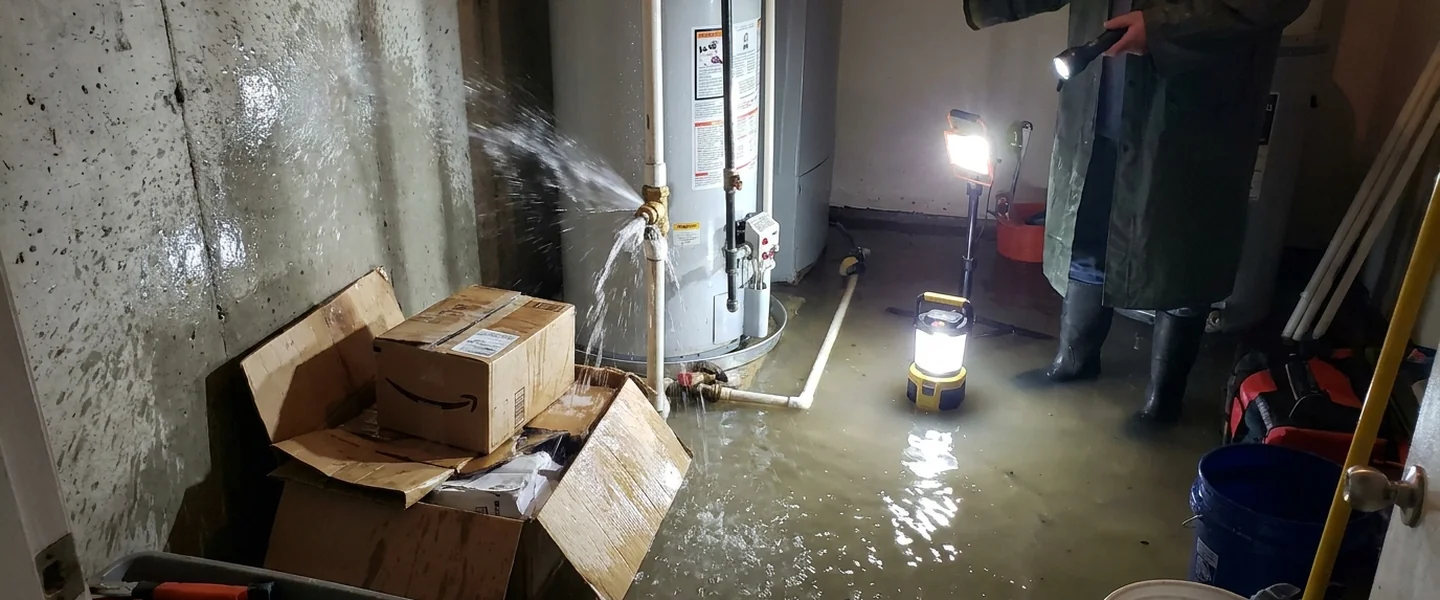
A burst pipe in your Plano home is one of the worst experiences a homeowner can face — and the first 30 minutes you spend on the response determines whether the loss is contained at a few thousand dollars or spirals into a six-figure insurance event. We see this every February in Frisco, Allen, McKinney, and across the Plano metro when sustained sub-freezing nights freeze attic-routed supply lines. The homeowner wakes up to water pouring through the ceiling. What they do in the next 30 minutes matters more than anything else that happens in the following week.
Minute 0-2: Shut Off the Water
Find the main water shutoff valve to your home. In most Plano-area homes it is located at the meter near the street (look for a rectangular metal cover on the curb), or at an interior shutoff usually mounted in the garage, the utility room, or behind a wall in the master bath. Turn the valve clockwise (right) until it stops. If you cannot find or operate the main valve, every supply line in your home has an individual shutoff at the fixture — under sinks, behind toilets, behind washing machines. Shut off whatever is closest to the active leak.
If you cannot identify the source: call Plano Water at the emergency number on your most recent bill and have them shut off at the meter. They typically dispatch within 30 minutes during emergencies.
Minute 2-5: Shut Off Electricity to Wet Areas
Never enter standing water with energized electrical circuits — that’s a lethal hazard. Go to your electrical panel and flip the breakers for any room where water is touching outlets, switches, or appliances. If you can’t safely reach the panel without entering wet areas, leave the home and call the utility company for emergency disconnect. Do not assume the power is off just because lights are out — energized circuits can still electrify standing water.
Minute 5-10: Call Your Restoration Company
Call us at (469) 513-8757. We answer 24 hours a day. The on-call technician will dispatch a truck-mounted extractor immediately and walk you through the next 20 minutes of safe actions while the crew is en route. Have your homeowners insurance information ready — policy number, claim number if you’ve already filed, adjuster contact if you have it. The faster the restoration company arrives, the less secondary damage compounds.
Minute 10-15: Document Everything
While waiting for the crew, photograph the loss thoroughly. Wide shots of every affected room, close-ups of the apparent source, ceiling damage, wall damage, floor damage, and any visible water lines. Take videos walking through the space narrating what you see. Pre-extraction documentation is the most valuable evidence in your insurance file — the more thorough, the cleaner the claim. Do not start cleanup yet; let the documentation capture the loss as it is.
Minute 15-20: File Your Insurance Claim
Call your homeowners insurance carrier and report the loss. Almost every carrier has a 24/7 claims line on the back of your insurance card or on the carrier’s app. Provide: the time the loss was discovered, the apparent source, the affected rooms, and the restoration company you’ve dispatched (us, if you’ve called). Get a claim number. You can also delegate this to the restoration crew once they arrive — we routinely handle the carrier call for clients who would rather focus on stabilizing the home.
Minute 20-30: Move Valuables and Mitigate Spread
Move valuables, electronics, documents, and irreplaceable items to a dry area of the home — but only if you can do so without entering standing water. Lift furniture legs onto blocks of wood, foil, or plastic so they don’t wick water up into the upholstery. If water is still entering an area (a continuing ceiling drip from above), place a bucket or tarp to contain it. Open windows in unaffected rooms if it’s safe and dry outside — air circulation reduces humidity. Do not use a household HVAC system to dry the home; it spreads moisture into ducts you don’t want it in.
What Not to Do in the First 30 Minutes
Do not enter standing water without confirming electrical shutoff. Period. Electrocution is the most common cause of injury in residential water emergencies.
Do not start cleanup before documentation. The insurance file values pre-extraction photos and videos more than anything else. Cleanup before documentation makes adjuster review harder.
Do not run your HVAC system. Moisture-laden air gets distributed into ducts and into unaffected rooms, expanding the affected area unnecessarily.
Do not attempt to extract Cat 2 or Cat 3 water with consumer equipment. Sewage and contaminated water require PPE-equipped crews following IICRC S500 Cat 3 protocol. A shop-vac is dangerous on contaminated water.
Do not delay the restoration call. Every hour secondary damage compounds. Microbial growth begins within 24-48 hours. The clock starts the moment the water hits the floor.
Plano-Specific Considerations
The most common burst-pipe scenarios in the Plano metro are: (1) attic-routed PEX or copper supply lines freezing during sustained sub-freezing winter nights, common in Frisco, Allen, and McKinney homes built 2000-2015; (2) Polybutylene (Quest piping) failures in 1970s-1980s Garland ranch homes — these fail catastrophically at fittings without warning; (3) builder-grade water heater failures around year 12, common in McKinney master-planned communities from 2005-2012; (4) slab leaks at copper-to-PEX transitions in Plano and Allen subdivisions. Each scenario has a different repair path and a different demo scope. Our crews arrive familiar with each pattern.
Insurance Claim Timeline
For a covered burst-pipe loss in the Plano metro: the claim is filed within 30 minutes of discovery. The carrier assigns an adjuster within 24-48 hours. We submit the Xactimate estimate to the adjuster within 24-48 hours of starting work. Most carriers approve the initial scope within a few business days. Supplements (if the moisture map expands during demo) are submitted as discovered and typically approved within a week. The dry-out completes within 5-10 days. Reconstruction (handled by a separate licensed GC) typically takes 2-6 weeks depending on scope. The claim closes when both restoration and reconstruction are complete.
Common Misconceptions About Burst Pipe Response
“I should clean up before the restoration company arrives.”
No. Pre-extraction documentation is what the insurance file values. Let the crew document, then extract.
“My homeowners insurance won’t cover this because it’s a pipe.”
Sudden and accidental pipe failures (frozen-burst, water-heater failure, supply-line failure) are covered under almost every standard Texas homeowners policy. Long-term seepage and unaddressed maintenance are excluded.
“I’ll save money by drying it myself.”
Drying without IICRC S500 protocol almost always leaves residual moisture in framing and subfloor. The mold that emerges 60-90 days later is then an excluded claim and the homeowner pays out of pocket for the remediation.
“It’s just a little water — I can wait until morning.”
Every hour matters. Drywall wicks moisture into wall cavities within minutes. Hardwood floors cup within hours. Mold starts at 24-48 hours. A 6 AM response window costs far less than waiting until 9 AM.
Bottom Line
The first 30 minutes after a burst pipe are the most important. Shut off the water, shut off electricity to wet areas, call us at (469) 513-8757 for 24/7 emergency response, document everything, file your claim, and stabilize the spread. Our truck-mounted extractors are typically on site within 60 minutes of dispatch across the entire Plano metro.
Plano-Area Service Areas
We respond 24/7 across Plano and the surrounding DFW suburbs. Click your area for local details and the housing-stock patterns we typically encounter:
Flooded? Call Now — 24/7 Emergency Response in Plano
Truck-mounted extractors dispatched within the hour. Direct insurance billing. Serving Plano and surrounding areas including Frisco, Allen, McKinney, Richardson, Carrollton, The Colony, Garland, Lewisville.