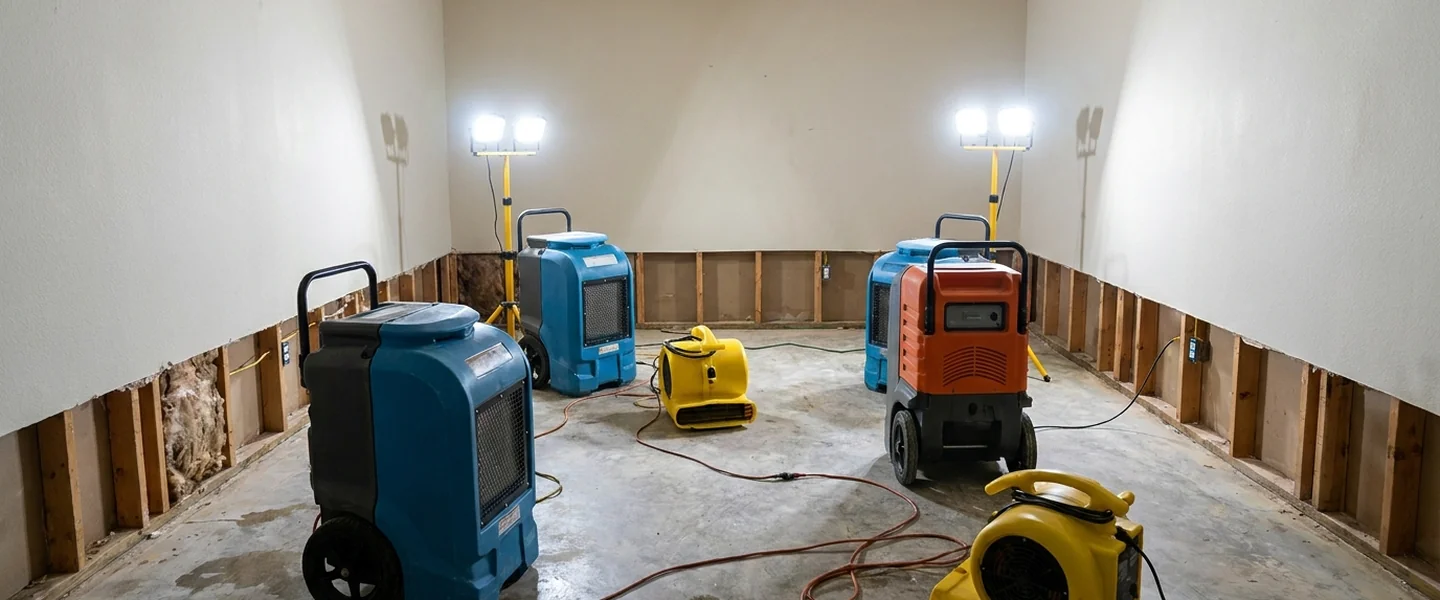
Structural Drying + Dehumidification in Plano, Texas
Commercial dehumidification and air movers monitored daily until moisture readings hit IICRC S500 dry standard.
- IICRC-Certified (WRT, ASD, AMRT)
- 24/7 Emergency Response
- Direct Insurance Billing
- Locally Owned, Plano-Based
- Free On-Site Damage Assessment
What Structural Drying + Dehumidification Means in Plano, TX
Structural drying is the active dry-out phase that follows bulk water extraction. The IICRC S500 standard for water damage restoration prescribes the methodology — air movers and commercial dehumidifiers deployed to move moisture out of wet materials and out of the home’s atmosphere, with daily moisture readings logged until each affected material reaches its published dry standard. In the Plano climate, with summer humidity often above 70% and limited outside-air drying capacity for much of the year, mechanical dehumidification is the only reliable path to a complete dry-out.
The Plano metro’s specific climate and housing stock make this work especially time-critical. We see homeowners in Frisco, Allen, McKinney, Richardson, Carrollton, The Colony, Garland, and Lewisville call us in the middle of the night during the February freeze cycle and during April-June supercell season. The faster the response, the less secondary damage compounds — drywall wicking, hardwood cupping, microbial growth — and the cleaner the insurance claim ends up. That is why we operate 24/7 with truck-mounted extractors staged across the DFW metro.
Project Details
| Service Area | Plano, TX plus Frisco, Allen, McKinney, Richardson, Carrollton, The Colony, Garland, Lewisville |
|---|---|
| Response Window | Typically on-site within 60 minutes, 24 hours a day, 365 days a year |
| Job Duration | 3-7 days on site (varies with loss size, water category, and affected materials) |
| Materials Used | Truck-mounted extractors; LGR commercial dehumidifiers; centrifugal air movers; EPA-registered antimicrobials (Microban Mediclean, Benefect Decon 30); HEPA air scrubbers for Cat 3 and mold remediation |
| Certifications | IICRC WRT (Water Damage), ASD (Applied Structural Drying), AMRT (Mold Remediation) |
| Crew Size | 2-4 technicians for residential, scaled up for commercial losses, including the technician who handled your initial response |
| Insurance Billing | Direct billing through Xactimate to all major U.S. carriers |
| Investment | Quoted per job after a free on-site damage assessment — every estimate is itemized in Xactimate line-item format for direct insurance submission |
Our Process
Every structural drying + dehumidification job in the Plano metro follows the same disciplined sequence regardless of size. We do not skip steps because of scheduling pressure, and we do not bid work that requires shortcuts on the IICRC S500 or S520 protocols.
Step 1: Initial moisture mapping
Calibrated moisture meters and thermal-imaging cameras map every wet material in the affected space — drywall, framing, subfloor, hardwood, baseboards, insulation, and concrete slab if applicable. The mapping becomes the moisture log we update daily.
Step 2: Equipment sizing per S500
The number and capacity of air movers and dehumidifiers is calculated from the cubic footage of the affected space, the materials’ moisture content, and the Plano ambient conditions. Undersized equipment fails to hit dry standard; oversized wastes time and money. We size to the standard.
Step 3: Equipment placement
Air movers create high-velocity airflow across wet surfaces. Dehumidifiers (LGR — low-grain-refrigerant — typically) remove the moisture the air movers bring into the room air. Placement is calculated, not random.
Step 4: First-24-hour moisture pull
Hour-1 ambient humidity is captured. The first 24 hours typically see the largest moisture removal. Equipment counts are highest in the first day and adjusted down as the dry-out progresses.
Step 5: Daily moisture log
Technicians visit daily, take moisture readings at every mapped point, log them with timestamps, and adjust equipment placement based on the data. This is not a set-and-forget service.
Step 6: Dry-standard verification
Each material has a published dry standard (wood typically 15% MC, drywall typically 1% MC by capacitance, concrete typically 4% by capacitance). When every mapped point hits the standard, we close the dry-out.
Step 7: Documentation handoff
The complete daily moisture log, photo documentation, and equipment record goes to your insurance file. Adjusters routinely request this packet and it shortens the claim cycle when delivered cleanly.
Equipment and Materials We Use
The equipment list is a function of the IICRC standards we follow. Each item on the list is selected because it produces a measurable, documentable result in the moisture log:
| Extraction Equipment | Truck-mounted extractors (up to 200 gallons/hour), portable extractors for tight spaces |
|---|---|
| Air Movers | High-velocity centrifugal air movers, typically 12-30 per residential loss |
| Dehumidifiers | Commercial-grade LGR (low-grain-refrigerant) dehumidifiers, sized per IICRC S500 |
| Antimicrobials | EPA-registered (Microban Mediclean, Benefect Decon 30) applied at manufacturer’s published dwell time |
| PPE | Tyvek suits, P100 respirators, nitrile gloves for Cat 2 and Cat 3 losses |
| Documentation | Thermal imaging, calibrated moisture meters, Xactimate sketch packages, daily moisture logs |
Common Scenarios We See in Plano Homes
The Frozen Attic Pipe Burst
The most common February claim across Frisco, Allen, and McKinney. Attic PEX line freezes during a sustained sub-freezing night, expands, bursts, and pours thousands of gallons through the ceiling. Response: emergency extraction, ceiling demo, full structural drying.
The Slab Leak Wicking Up Walls
Common in 1990s-2010s slab-on-grade construction across Plano and Allen at copper-to-PEX transitions. The wet line wicks up the wall plates and saturates baseboards and lower drywall before the homeowner notices a stain.
The Cat 3 Sewer Backup
Common in older Garland and Richardson homes during heavy rain when the municipal main backs up into low-floor drains. Full hazmat PPE, containment, EPA-registered disinfection, and documented PRV.
The HVAC Condensate Ceiling Drip
Common across the metro in attic-mounted units 10+ years old. The condensate pan rusts through and drips ceiling-board water for weeks before the homeowner notices the stain. Demo, remediation if mold has set, and dry-out.
Why Plano Homes Need This Service
The Plano metro sits in a climate corridor that produces water-damage losses on a predictable annual cycle. Spring (April-June) brings supercell rainfall, hail, and straight-line winds that breach roofs and overflow retention ponds. Summer brings sustained ambient humidity above 70%, which means any water event without active mechanical drying turns into a microbial-growth event within 24-48 hours. Winter (December-February) brings the freeze-and-thaw spike that has dominated DFW restoration calendars since the 2021 winter storm. Houston Black and Austin Stony expansive clay produces year-round slab-perimeter cracking, opening pathways for stormwater and ground-water intrusion. Structural Drying + Dehumidification addresses these losses with the IICRC-defined methodology that produces consistent, documentable, insurance-billable outcomes — not shortcuts.
Insurance Documentation in Detail
Most Plano-area homeowners interact with their carrier directly only a few times in their adult lives, and water-damage claims are some of the most expensive personal-lines losses a carrier handles. Clean documentation is the difference between a smooth claim and a contested one. Our documentation packet for every job includes: pre-extraction photographs of the loss as we found it, the source identification, the IICRC water category determination, the daily moisture log with timestamped readings at every mapped point, equipment placement records, antimicrobial application records with dwell-time documentation for Cat 2 and Cat 3 work, demo scope itemized to room and material, Xactimate-format line-item pricing in the format your carrier expects, and a post-remediation report when applicable. This packet goes to your adjuster directly. We have collected on more than 99% of submitted claims because the documentation does the work.
How We Quote (After the Initial Free Assessment)
We do not quote structural drying + dehumidification over the phone, because the scope is determined by the water category, the affected materials, the cubic footage of the dry-out, and the rebuild coordination — none of which we can see from your description alone. Instead, we respond to your call, perform the initial damage assessment on site at no cost, and present the Xactimate-format estimate to your adjuster within 24 hours. The estimate is itemized to the line — every cubic foot of dehumidification, every foot of baseboard demo, every square foot of antimicrobial treatment — at the unit pricing your carrier uses. There are no surprises and no padding. If you find a comparable Xactimate estimate from another Plano-area restoration company, we will review it free of charge and tell you whether the scope and pricing match the actual damage.
After the Dry-Out
We follow up at 30 days and again at 12 months on every structural drying + dehumidification job in the Plano metro. The 30-day check verifies no residual moisture is wicking back into framing and no microbial growth has emerged in formerly-wet materials. The 12-month check is a more thorough visual inspection, with documented moisture readings if any concerns surface, and a written follow-up report you can keep for your file. If between visits anything seems off — a musty smell, a stain returning, a hardwood plank cupping — call us. The same technician who ran your dry-out handles the follow-up.
What We Don’t Do
We do not perform the structural reconstruction phase — drywall installation, paint, flooring, trim — ourselves. We coordinate with licensed Plano-area general contractors for the rebuild and we provide the demo and dry-out documentation those contractors need to scope the work. We do not do electrical repair; we coordinate with licensed electricians when a loss has compromised wiring. We do not perform plumbing repair on the source itself; we coordinate with licensed plumbers who make the supply-line or drain-line repair while we extract. Specialization keeps the work consistent and the warranty clean.
Service Areas
We perform structural drying + dehumidification across Plano and these surrounding suburbs: Frisco, Allen, McKinney, Richardson, Carrollton, The Colony, Garland, Lewisville.
Frequently Asked Questions
How fast can you respond to a structural drying + dehumidification call in Plano?
For most Plano-area addresses we are on site within 60 minutes of dispatch, 24 hours a day. Our crews stage equipment across the DFW metro so the response window holds during peak loss seasons — spring supercell rainfall and the February freeze-and-thaw spike. Call (469) 513-8757 from the home and we will roll a truck immediately.
Do you bill insurance directly?
Yes. We invoice through Xactimate, the same line-item estimating platform every major U.S. carrier uses. We collect your policy and claim numbers when we arrive and communicate with your adjuster directly. Your out-of-pocket is typically only the deductible.
Are you IICRC-certified?
Yes. Our technicians hold the Water Damage Restoration Technician (WRT), Applied Structural Drying (ASD), and Applied Microbial Remediation Technician (AMRT) certifications from the IICRC. These credentials are on the work documentation in your insurance file.
How long does structural drying + dehumidification typically take in Plano homes?
For a typical Plano-area home this service runs 3-7 days on site, with the actual timeline depending on the size of the loss, the water category, and the materials affected. Cat 1 (clean) losses dry faster than Cat 2 or Cat 3 because there is less demo and no antimicrobial dwell time. We give you a daily plan within the first 24 hours.
Will I need to leave the house?
Most {city}-area Cat 1 (clean water) losses don’t require you to leave the home — equipment runs continuously but you can live around it. Cat 3 (sewage) losses do require evacuation of the affected area until disinfection and air scrubbing are complete. Severe whole-home losses sometimes require alternate housing, which most homeowners policies cover under ALE (additional living expense).
What happens to my contents during the work?
We pack out (move and inventory) contents from the affected area to a clean dry space inside the home, or to off-site storage if the loss is whole-house. The pack-out is documented with a contents inventory list that goes to your insurance file. Contents cleaning and pack-back happens at the end of the dry-out.
Will you coordinate with my adjuster?
Yes. We communicate with your adjuster directly — phone, email, and Xactimate sketch packages — so you don’t have to act as the messenger between the carrier and the restoration team. Most Plano-area carriers know our work and the claim cycles run quickly when documentation is clean.
Will the carpet need to be replaced?
Carpet itself can usually be salvaged if extraction and drying begin within 24 hours. Carpet pad almost always has to be replaced — it absorbs water like a sponge and cannot be effectively dried in place. For Cat 2 or Cat 3 losses the entire carpet system is typically replaced as part of the demo scope.
Is the mold dangerous?
It depends on species, extent, and individual sensitivity. Stachybotrys (black mold) and certain Aspergillus species produce mycotoxins that affect sensitive individuals. Even non-toxigenic species are problematic for people with allergies, asthma, or compromised immune systems. We document species and extent when sampling is appropriate and recommend a remediation plan proportional to the risk.
What if you find more damage than the original assessment?
Supplements are a normal part of restoration work. If we open a wall and find the moisture extends further than the initial moisture map showed, we document it, update the Xactimate scope, and submit the supplement to your carrier. We do not surprise you with an out-of-pocket increase — supplements get adjuster approval before the additional work proceeds.
Plano-Area Service Areas
We respond 24/7 across Plano and the surrounding DFW suburbs. Click your area for local details and the housing-stock patterns we typically encounter:
24/7 Structural Drying + Dehumidification in Plano
Truck-mounted extractors dispatched within the hour. Direct insurance billing. Serving Plano and surrounding areas including Frisco, Allen, McKinney, Richardson, Carrollton, The Colony, Garland, Lewisville.
What You Get in Our Quote vs. the Lowball Bid
We don’t compete on the lowest sticker price — we compete on the quote that gets the job actually done. Here is what is included in every quote we write, and the cut-corners that show up in cheaper bids.
Included in our written quote
- IICRC-certified extraction + drying crews
- Daily moisture mapping with calibrated meters
- Insurance billing via Xactimate
- Antimicrobial + dehumidification per IICRC S500
- Documentation packet for your claim file
- No-charge re-check after job closes
Cut corners in the lowball bid
- Generic 'quick dry' without monitoring
- Subbed-out crews you don't recognize
- Hidden line items added mid-job
- Skipping antimicrobial treatment
- Pressuring you to sign assignment-of-benefits
- Vague non-Xactimate estimates