How Much Does Water Damage Restoration Cost in Plano, TX?
24/7 emergency response across the Plano metro from IICRC-certified water restoration specialists.
- IICRC-Certified (WRT, ASD, AMRT)
- 24/7 Emergency Response
- Direct Insurance Billing
- Locally Owned, Plano-Based
- Free On-Site Damage Assessment
Pricing for water damage restoration in the Plano metro is one of the most confusing things a homeowner deals with mid-emergency. Restoration estimates can range from a few thousand dollars for a small Cat 1 supply-line failure to six figures for a whole-house Cat 3 sewer backup with full structural drying and mold remediation. The variance is driven by the actual scope of the loss — and any honest restoration company needs to see the damage in person before writing a meaningful number. This post explains what drives the cost and what to look for when you compare estimates, without quoting a number we couldn’t honor without inspecting your specific loss.
The Six Factors That Actually Determine Water Damage Restoration Cost
1. Water category. The single biggest cost driver after square footage. IICRC S500 defines three categories: Cat 1 (clean — supply line, ice maker, water heater failure), Cat 2 (gray — dishwasher discharge, washing machine, some toilet overflows), and Cat 3 (black — sewage, ground-water intrusion, multi-day standing water). Cat 3 is dramatically more expensive than Cat 1 because it requires full hazmat PPE, sealed containment, EPA-registered disinfection with documented dwell times, and significantly broader demo scope (entire affected drywall panels rather than just 2 feet up from the wet line).
2. Square footage of affected area and material count. A 200 sq ft kitchen flood from a dishwasher line costs less than a 2,000 sq ft whole-house extraction following a frozen-burst attic line. Air mover count, dehumidifier count, demo labor, and antimicrobial coverage all scale with affected area. Honest Plano-area estimates will show the exact square footage mapped during the moisture survey.
3. Affected materials. Drywall is cheap to demo and replace. Hardwood and engineered wood floors are expensive — they often need to be removed in full, and reconstruction includes acclimation and refinishing. Tile on slab is usually salvageable. Carpet and pad: pad almost always replaces, carpet can sometimes be salvaged if extraction begins within 24 hours. Cabinetry is highly variable. The estimate should specify which materials are being kept and which are being removed.
4. Mold complications. If the water sat for more than 48 hours before extraction began, mold is likely present. Mold remediation per IICRC S520 adds containment, PPE, demolition of contaminated porous materials, antimicrobial treatment, and post-remediation verification testing. Plano’s climate accelerates mold growth — summer ambient humidity above 70% means any wet substrate is at risk within a day. Mold complications can easily double the original cost.
5. Reconstruction scope. The restoration estimate covers extraction, demo, drying, and antimicrobial. Reconstruction (drywall install, paint, flooring, trim, cabinetry rebuild) is a separate scope handled by a licensed general contractor. Some restoration companies bundle the reconstruction; we coordinate with independent GCs because that keeps the lines clean for insurance billing. The total project cost is the restoration estimate plus the reconstruction estimate.
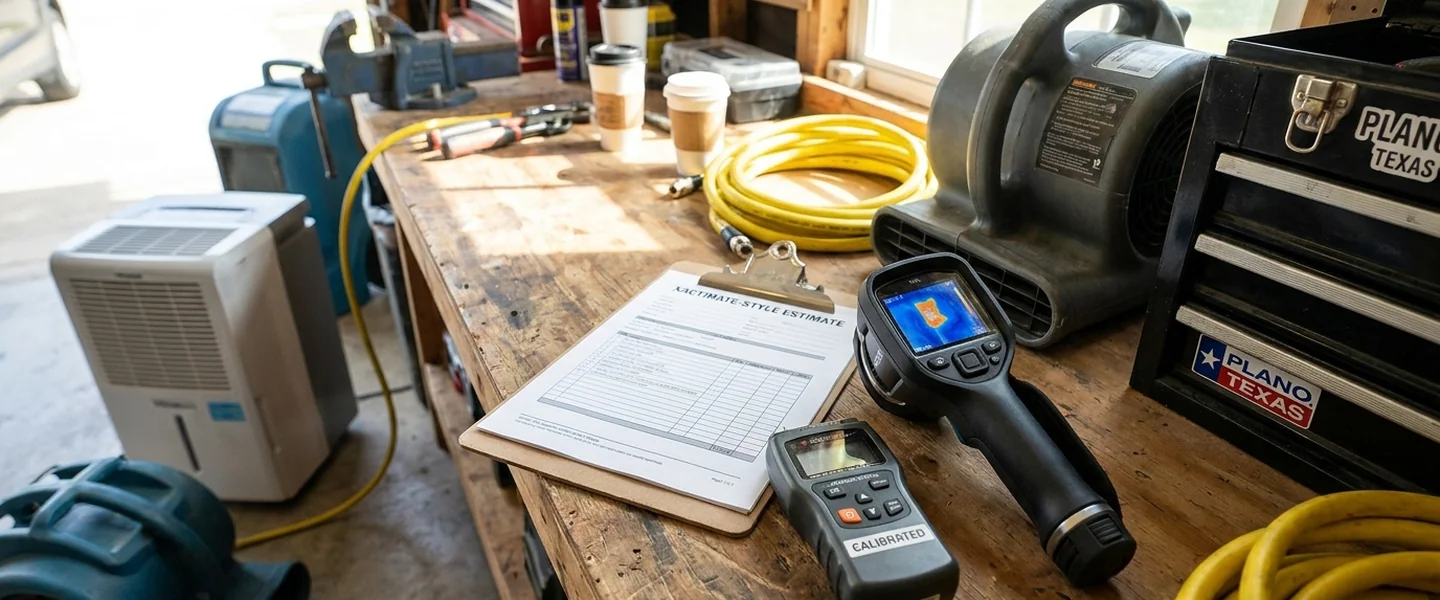
6. Insurance carrier and Xactimate pricing. Every major U.S. carrier uses Xactimate for property claims. Xactimate publishes regional unit pricing that updates quarterly. A Plano-area restoration estimate billed at Xactimate line-item pricing is the unit-cost-by-line-item structure your adjuster expects — there is no “padding” because the prices are published. If your estimate uses a flat-rate format instead of Xactimate line items, that’s a red flag.
What a Quality Restoration Estimate Looks Like in Plano
A good written estimate for Plano-area water restoration is itemized in Xactimate format. It should include: water category, room-by-room moisture map with sq ft affected, demo scope itemized by room and material, antimicrobial application with sq ft coverage and product, structural drying with equipment count (air movers, dehumidifiers) and days expected, daily monitoring entries, and the IICRC certification of the technicians performing the work. An estimate that just says “Water Damage Restoration” with a single bottom-line figure and no breakdown is hiding something, usually scope or unit pricing that won’t survive adjuster review.
Questions to Ask the Contractor
- What IICRC water category do you classify this loss?
- Do your technicians hold WRT, ASD, and AMRT certifications?
- Do you bill in Xactimate line-item format directly to my carrier?
- Will the same technician who responded to my call run the dry-out daily?
- What is your moisture-log documentation procedure?
- Do you handle the reconstruction in-house or coordinate with a GC?
What Not to Do
Don’t accept a phone quote — the scope can’t be assessed without seeing the damage. Don’t sign anything that says you’ll cover the deductible portion in exchange for the company “waiving” it — that’s insurance fraud and it voids your coverage. Don’t pay more than 25-33% upfront. Don’t accept an estimate that doesn’t specify the water category and the IICRC standard being applied. Don’t take the cheapest estimate without comparing scope — saving on extraction day usually means a contested claim and uncovered secondary damage later. And don’t delay starting the dry-out to “shop around” — every hour matters and the carrier expects fast response from the homeowner.
Plano-Specific Considerations
The Plano metro has factors that affect cost in ways national-franchise pricing models miss. The expansive black clay produces seasonal slab-perimeter cracking that opens water-entry paths year-round. Spring supercell rainfall and the February freeze-and-thaw spike cluster claims into specific weeks, which can affect equipment availability and pricing if your loss happens during a regional event. Plano’s mix of newer master-planned subdivisions in Frisco and Allen versus older 1970s-1980s housing stock in Garland and Richardson means scope varies dramatically across the metro — an estimate that doesn’t reflect your specific housing-stock failure pattern is suspect.
Common Misconceptions About Restoration Cost
“The cheapest quote is the best quote.”
Almost always wrong. The cheapest estimate in the Plano metro is typically missing scope — undersized dehumidifier count, demo that doesn’t follow S500 for the water category, or no antimicrobial coverage. The hidden cost shows up in years 1-3 when mold emerges in formerly-wet framing and the homeowner pays for the original loss plus the remediation, this time out of pocket because the insurance claim is closed.
“The most expensive quote must be the best.”
Often a national franchise selling a “comprehensive package” that bundles unnecessary scope (full carpet replacement when carpet is salvageable, premium reconstruction materials when standard is appropriate). The same IICRC-certified work installed by a local specialist usually runs less because there is no franchise overhead.
“I can DIY this with a shop-vac.”
You can pull bulk water with a shop-vac. You cannot dry a building to IICRC S500 standard with consumer equipment, you cannot document the dry-out for insurance, and you cannot prevent the secondary mold growth that almost certainly occurs in Plano’s climate without active dehumidification. The DIY path saves money on day one and almost always costs more by month six.
“All restoration companies are basically the same.”
Strongly disagree. The dispatcher-subcontractor model (most national franchises) and the responding-tech-runs-the-job model (independent specialists like us) produce dramatically different outcomes for the same loss. Ask about the model before you ask about the price.
Bottom Line
The right price for water damage restoration in Plano is the one that comes from an on-site assessment by an IICRC-certified technician who will also run the dry-out, that specifies the water category and the IICRC standard being applied, that itemizes in Xactimate line-item format for direct insurance submission, and that addresses any mold or secondary damage as part of the original scope. Call (469) 513-8757 for a free on-site assessment 24/7 and a written estimate submitted to your carrier within 24 hours.
Plano-Area Service Areas
We respond 24/7 across Plano and the surrounding DFW suburbs. Click your area for local details and the housing-stock patterns we typically encounter:
Flooded? Call Now — 24/7 Emergency Response in Plano
Truck-mounted extractors dispatched within the hour. Direct insurance billing. Serving Plano and surrounding areas including Frisco, Allen, McKinney, Richardson, Carrollton, The Colony, Garland, Lewisville.