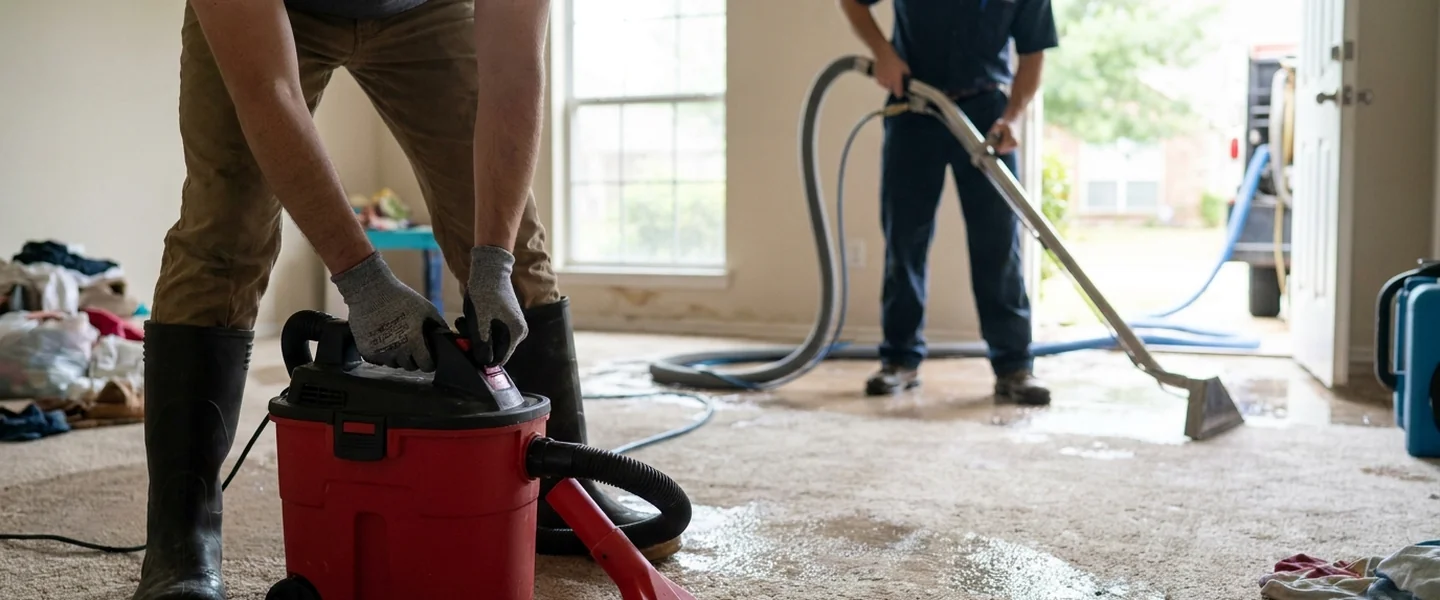
Why DIY Flood Cleanup Costs More in the Long Run
24/7 emergency response across the Plano metro from IICRC-certified water restoration specialists.
- IICRC-Certified (WRT, ASD, AMRT)
- 24/7 Emergency Response
- Direct Insurance Billing
- Locally Owned, Plano-Based
- Free On-Site Damage Assessment
The DIY question comes up on almost every Plano-area water damage call. The homeowner sees the standing water, sees the dollar signs adding up in their head, and thinks “I have a shop-vac, I have some fans, I can handle this myself.” We understand the impulse — and we’ll tell you honestly when the loss is small enough that DIY might actually work. But for most residential water damage in the Plano metro, DIY costs significantly more in the long run than calling a restoration company on day one. This post explains why.
The Hidden Costs of DIY Flood Cleanup
1. Residual moisture in framing and subfloor. Surface water comes out with a shop-vac. The water that wicked into the wall plates, into the bottom 12 inches of drywall, into the subfloor below the carpet pad, and into the joist cavities does not. Without commercial dehumidification deployed per IICRC S500, that residual moisture stays in the framing for weeks. The visible surfaces look dry; the structure isn’t. Within 60-90 days mold establishes in the formerly-wet materials and the homeowner now faces a remediation that the insurance carrier may deny because the original loss wasn’t documented or scoped properly.
2. Mold remediation out of pocket. When mold emerges from a poorly-dried loss, the carrier often denies remediation because: (a) the original claim was closed (or never opened); (b) the mold is technically a “secondary” damage from inadequate response, which most policies exclude; (c) the homeowner cannot document IICRC-standard drying. The remediation then comes out of pocket — typically tens of thousands of dollars for a moderate-scope job — which is dramatically more than the deductible would have been on the original claim.
3. Insurance claim denial or under-payment. Most Texas homeowners policies have language about prompt notice of loss and reasonable mitigation efforts. A homeowner who delays notice while attempting DIY drying can face denial on prompt-notice grounds. Even when the claim is accepted, the carrier may pay only for the visible damage they can verify, not for the residual-moisture damage the homeowner can’t document. Without IICRC-certified work and a daily moisture log, the file is weak.
4. Reconstruction problems 6-18 months later. Drywall installed over wet framing develops staining and warping. Hardwood floors installed over wet subfloor cup, gap, and squeak. Cabinetry installed against wet wall plates pulls away from the wall. We routinely see homes 12-18 months after a DIY flood cleanup where the reconstruction is failing because the underlying structure was never properly dried.
5. Health risk to the household. Standing water in residential settings frequently contains contaminants — bacteria, biological matter, chemicals from cleaning products. DIY cleanup without proper PPE exposes the household to these contaminants. Mold that establishes after inadequate drying releases spores into breathing air, affecting allergy-prone, asthmatic, and immunocompromised members.
6. Time and effort lost. A typical residential water loss takes a professional crew of 3-4 IICRC-certified technicians with commercial equipment 5-10 days to fully address. A DIY attempt by a homeowner with a shop-vac and household fans often takes the same calendar time but produces a fraction of the actual drying — meaning the homeowner spent days of personal time and still got a worse outcome than a 3-day professional dry-out.
When DIY Actually Works
We’ll be honest: there are scenarios in the Plano metro where DIY is appropriate. A small Cat 1 water spill confined to a hard-surface floor (tile, sealed concrete), with no carpet, no drywall contact, and no subfloor exposure — that’s a mop-and-fan job. Water from a known clean source that you contained within 5-10 minutes of release and that affected less than 10 sq ft of hard surface — that’s a DIY job. Anything beyond that — water touching drywall, carpet, hardwood, cabinetry, or subfloor — needs professional response.
What Professional Restoration Provides That DIY Can’t
Truck-mounted extraction. A truck-mounted extractor pulls 200+ gallons per hour, dramatically faster than a residential shop-vac, and reaches through carpet into pad and subfloor in ways consumer equipment can’t.
Commercial-grade dehumidification. LGR (low-grain-refrigerant) commercial dehumidifiers remove moisture from the room air at rates 10-30x what a household dehumidifier does. The capacity matters in Plano’s humid climate.
IICRC-certified scope. The S500 standard defines what dries, what demos, what gets antimicrobial, and what the dry standard is. Without certification, the scope is guesswork.
Daily moisture documentation. Adjusters trust documented daily readings. Homeowner-claimed “it looks dry” is not documentation.
Xactimate-format insurance billing. The estimate goes to the carrier in the format they expect, with line items at published unit pricing. The claim approves faster.
Post-loss follow-up. 30-day and 12-month follow-up visits catch residual issues before they become full secondary damages.
Plano-Specific Considerations
The Plano metro’s expansive clay, summer humidity, and seasonal storm patterns make DIY drying particularly risky. Houston Black clay holds and releases moisture into slab-on-grade construction year-round, so a slab-leak DIY attempt almost never captures the full extent of the moisture. Summer ambient humidity above 70% means household dehumidifiers cannot keep up with the moisture load — the dry-out runs in slow motion if at all. Spring supercell rainfall produces Cat 2 and Cat 3 losses that DIY equipment isn’t safe for. Each of these factors compounds the case for professional response.
The Cost Math Over Time
Consider a typical Plano-area Cat 1 burst-pipe loss. Professional restoration: covered by insurance, homeowner pays deductible only, dry-out completes in 3-5 days, no secondary damage 6 months later, full documentation in the file. DIY attempt: no insurance coverage (because the homeowner didn’t file or filed late), homeowner pays full cost out of pocket, “completes” in 5-7 days with residual moisture remaining, mold emerges in 60-90 days, remediation costs significantly more than the original loss would have, and the carrier denies because the documentation isn’t there. Total cost difference over a 12-month horizon: DIY typically costs 3-5x what professional restoration would have cost.
The “I Already Started” Scenario
If you’ve already started DIY cleanup and now you’re realizing the scope is bigger than you thought, call us. We can take over mid-job. We do an assessment of where the drying actually is — which is usually well behind where the homeowner thinks it is — and we resume the professional protocol from that point. The earlier you call, the less of the residual damage compounds. We’ve taken over from DIY attempts on day 2, day 5, and even day 14, and each successive day adds to the scope.
Common DIY Mistakes We See in Plano Homes
“I extracted the water and turned on the AC.”
The AC moves humid air through ducts and into unaffected rooms. The moisture spreads. The AC also doesn’t have the dehumidification capacity to dry a wet building — commercial LGR dehumidifiers are 10-30x more capable.
“I used a household fan.”
Household fans move air at low velocity. Air movers for restoration produce 2,000-3,000 CFM at high velocity, dramatically more effective at moisture evaporation.
“I cut out the drywall myself.”
Cutting drywall without containment spreads dust, mold spores (if any), and contaminants into the rest of the home. Cat 2 and Cat 3 demos require containment and PPE.
“I cleaned with bleach.”
Bleach is ineffective on porous substrates like wood — the chlorine breaks down before penetrating. EPA-registered antimicrobials formulated for the substrate (Microban Mediclean, Benefect Decon 30) are what works.
“It’s been a week and the smell is gone, so it must be dry.”
Smell is not a moisture indicator. We routinely take moisture readings on “dry-feeling” subfloors and frames that come back at 25-35% MC — well above dry standard. The structure is wet even when the surface and the air seem fine.
Bottom Line
For all but the smallest hard-surface Cat 1 spills, DIY flood cleanup in Plano homes costs more in the long run than calling a restoration company on day one. Insurance coverage, IICRC-certified scope, commercial equipment, daily documentation, and 30-day/12-month follow-up are not luxuries — they’re what prevents the loss from compounding into something far worse. Call (469) 513-8757 for a free on-site assessment 24/7 and we’ll tell you honestly whether the loss is DIY-appropriate or whether you need a professional response.
Plano-Area Service Areas
We respond 24/7 across Plano and the surrounding DFW suburbs. Click your area for local details and the housing-stock patterns we typically encounter:
Flooded? Call Now — 24/7 Emergency Response in Plano
Truck-mounted extractors dispatched within the hour. Direct insurance billing. Serving Plano and surrounding areas including Frisco, Allen, McKinney, Richardson, Carrollton, The Colony, Garland, Lewisville.